Monday, January 31, 2011

Pulp Poem of the Week


Only dumb guys fight.
If I wasn't dumb
I wouldn't be fightin'.
I could make six dollars a day
On the docks
And I'd save more than I do now.
Only dumb guys fight.
Langston Hughes
"Prize Fighter"
1927

Wednesday, January 26, 2011

Book Review: Richard Stark, The Dame (1968)


Richard Stark writes an Agatha Christie novel, starring Alan Grofield. Ugh. Grade: C-

Monday, January 24, 2011

Noir Flow Chart


Pulp Poem of the Week


Clinger was sitting
hunched in a chair
like a bankrupt laundromat owner
in his lawyer's outer office.
Richard Stark
The Seventh
1966

Thursday, January 20, 2011

5 Quick Questions with Max Allan Collins


Max Allan Collins has cut a wide swath through the noirboiled world (and many other literary worlds, for that matter) as a prolific author of novels (graphic and otherwise), stories, screenplays, movie tie-ins, comic strips, and on and on. He is perhaps best-known to noirboiled fans for the Nathan Heller novels, which blend the private eye genre with historical fiction, as well as his series featuring Quarry (the assassin) and Nolan (the thief).

1. What is the first crime novel that you remember reading?

I read a lot of the Sherlock Holmes stories, and loved the Saint novels—I particularly remember The Saint and the Sizzling Saboteur making an impression. And the Dick Tracy comic books are a very vivid memory—the first story I read was about Junior Tracy’s girl friend, Model, who died as a result of her juvie brother’s misdeeds, quickly followed by a book collecting the Brow sequence, in which the sympathetic Summer Sisters drowned in a car. But the crime novel that kicked off everything came in the seventh grade—The Maltese Falcon. Still my favorite private eye novel.

2. Which crime novelist do you consider to be your biggest influence?

I have to dodge this, at least somewhat. Everybody thinks I would say Mickey Spillane, but he is only one of a quartet of great mystery writers I discovered when I was thirteen—Dashiell Hammett, Raymond Chandler, Mickey Spillane, and James M. Cain. I learned 90% of what I know about crime writing from Hammett, Chandler, Spillane, and Cain.

3. Which non-crime novelist do you consider to be your biggest influence?

Probably William March, author of The Bad Seed, which inspired my films (and novels) Mommy and Mommy's Day. My other favorite mainstream writers during my impressionable years were Calder Willingham, who wrote End As a Man, and Willard Motley, who wrote Knock on Any Door. Not your standard picks, I’ll grant you. Later I came to like Mark Harris, author of The Southpaw.

4. Which crime novel (that you didn’t write) do you most wish you had written?

There aren't any. I only want to write my novels.

But I am very thrilled to be collaborating with Mickey Spillane—contributing real entries to the Mike Hammer series is an honor I wish I could share with my thirteen year-old self. Well, I guess I do.

5. What is the best novel by Max Allan Collins?

I don't know. I would suggest that the Nathan Heller novels, taken as a whole, represent my best work and major contribution. Of those I might pick The Million-Dollar Wound as the best representative example, and Flying Blind as the best atypical entry.

Monday, January 17, 2011

Pulp Poem of the Week


There was no question
Nola was nice to look at,
and now that she was getting
moodier and quieter,
all the better.
Dave Zeltserman
Pariah
2009

Sunday, January 16, 2011

Book Review: Dave Zeltserman, Outsourced (2011)


Dan Wilson is out of work and on the verge of losing his eyesight. With a mortgage to pay and a family to support, he is an ordinary guy desperate for money. He conceives a can’t-miss bank heist, enlists the help of some friends, and then—surprise!—things don’t go exactly as planned. Dave Zeltserman cleverly and effectively engineers the plot with a steady supply of action and surprises. In sum, Outsourced is thoroughly entertaining noir in a traditional vein. Grade: A-

Friday, January 14, 2011

Noirboiled Turkey


As a result of suffering through my first Lemmy Caution novel a few months back, I have developed a bemused interest in the career of British ersatz-hardboiled writer Peter Cheyney, such that I couldn’t resist the chance to purchase a Cheyney novel translated into Turkish. The title of the Turkish translation, Kanli Oyun, means Bloody Game, which bears no obvious connection to the original titles of any Peter Cheyney novels.

If you visit this series of cover galleries of Turkish translations of noirboiled novels, you will quickly discover that the standard practice of Turkish translators/publishers was to change titles. I am still trying to imagine which Mickey Spillane novels have been published in Turkey as Battle of the Giants, Murderer of the Full Moon, Guns Won’t Talk, The Revenge Claw, Teenager Hell, I’m Afraid of the Blondes, You’ll Spit Blood, Alive Target, Hands of Dark, and Murderer with Green Hand. I’m the Judge is obviously I, the Jury, but beyond this, I’m baffled.

So which Peter Cheyney novel do I have? This is the opening paragraph in Turkish:

Yasamak bazan ne kadar zevkli oluyor. Fakat ben su anda hayatin tadini alamayacak kadar efkârliydim. 1945 Martinda Pariste hemen bütün erkekler ekfârliydi. Bu efkârin da bir tek sebebi vardi: Yosmalar.

And this is the glorious translation that I get from Google Translate:

How much fun is going to live sometimes. But right now I get to enjoy life efkârliydim. Ekfârliydi in Paris in March 1945, almost all men. There was also the thoughts of a single reason: Yosmalar.

This may be gibberish, but it provides enough information for me to be sure that this is not a Peter Cheyney novel that I own. The Cheyney books I have eliminated are:

Can Ladies Kill?
Cocktails and the Killer
Dance Without Music
Dark Duet
Don’t Get Me Wrong
He Walked in Her Sleep
Poison Ivy
The Stars Are Dark
This Man Is Dangerous
Uneasy Terms
The Urgent Hangman
You Can Call It a Day
You Can’t Hit a Woman
You’d Be Surprised

Is there anybody out with the resources to eyeball a few more Peter Cheyney opening paragraphs? Any help figuring out which book this is will be much appreciated!

5 Quick Questions with John Pelan


John Pelan, who is most known as an author and publisher of horror and science fiction, has begun the ambitious project of publishing the complete short fiction of noirboiled writer Day Keene. The first two volumes of Keene stories—League of the Grateful Dead and Other Stories and We Are the Dead and Other Stories—have recently been published by Ramble House.

1. How did you become aware of Day Keene?

My buddy, the late Richard Laymon (tremendous author in his own right) and I were both fans of 1950s noir; and I recall him bringing Keene up as someone that I would likely enjoy. He was spot on!

2. What’s your favorite Day Keene story?

I’m rather fond of “League of the Grateful Dead,” but ask me tomorrow and I’ll likely have a different answer. . . . Keene was very versatile and depending on my mood, my preferences can run from weird menace such as the aforementioned to Doc Egg to a non-series mystery. . . .

3. What’s your least favorite Day Keene story?

I haven’t read everything yet, so I’ll pass on this one.

4. Do you have a favorite Day Keene novel?

Home Is the Sailor was the first novel I read, so I have a special fondness for it.

5. How did you go about about tracking down so many hard-to-find old pulps to collect Keene’s stories?

Well, I’ve been a collector and part-time bookseller for many years and have a lot of connections; that said, it hasn’t been easy!

Wednesday, January 12, 2011

Review: Richard Stark, The Green Eagle Score (1967)


Following The Rare Coin Score, The Green Eagle Score is another no-frills Parker heist novel. There are minor variations to the formula—this time, for example, we aren’t told the plan for the robbery until we see it enacted—but nothing remarkable that Stark hasn’t shown us before. In terms of the larger series, The Green Eagle Score is perhaps most notable for the further development of Paker’s character via his relationship with Claire, whom he met in The Rare Coin Score.
Grade: B-

Tuesday, January 11, 2011

Book Review Revisited: Max Allan Collins, Quarry [a.k.a. The Broker] (1976)


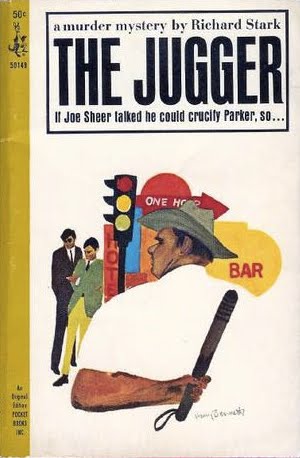
Max Allan Collins has posted his thoughts on my recent review of his novel Quarry here (about midway down the page). Collins is mistaken in saying that The Hunter is the only Parker novel where Parker kills a civilian—The Jugger is another that comes to mind. Parker thinks nothing of killing a civilian if it is necessary to ensure his own safety. Beyond this quibble, however, Collins' response, which emphasizes the differences between the Quarry novels and the Parker novels, makes an interesting counter to my review, which emphasized their similarities.

Monday, January 10, 2011

Pulp Poem of the Week


Don't ever
show a gun
to a man
you don't
want to kill.
Richard Stark
The Jugger
1965

Saturday, January 8, 2011

Review: Max Allan Collins, Quarry [a.k.a. The Broker] (1976)


If Max Allan Collins hadn’t written his Nolan novels, then Quarry would probably be known as his last-name-only homage to Richard Stark’s Parker. Collins freely admits that Nolan was a Parker rip-off, but he explains (in his afterword to the recently reissued Quarry) that with his Quarry novels he wanted to “take it up a notch” from the Parker/Nolan novels in two ways: First, Quarry would be a professional killer (rather than a professional thief). Second, Quarry would tell his own story in the first person (rather than the more detached third person of Parker/Nolan).

The plot contours of Quarry follow the typical Parker novel almost exactly: The book begins quickly and violently, then slows down as Quarry and a confederate plan a job. The job seems to go well at first, but then turns sour. At this point, if Quarry were smart, he would cut and run, but can’t bring himself to do it. He stays in town to make things right, which means, in part, recovering the fee for his job, which was stolen from him. The novel ends with Quarry at home, making contact with a woman he met while on the job. In sum, it’s a Parker novel.

As for Collins’ changes to the formula: The switch from thief to killer is not much of a change, given how much killing Parker does in the course of his work. Indeed, if you compare Quarry to The Hunter (the first Parker novel), there is nothing in Quarry half as chilling as the scene in The Hunter in which Parker accidentally kills the owner of a beauty shop, and the overall carnage in The Hunter is greater. As for the switch to a first-person narrative (and Collins’ decision to make Quarry “somebody just like [himself], just a normal person in his early twenties”), the result is that Quarry is more human and thus a less frightening character than Parker. The switch to first person also has the effect of simplifying the storytelling in Quarry. Among the most consistently entertaining aspects of the Parker novels are Stark’s clever and surprising shifts in time and point of view, which would be difficult, if not impossible, to accomplish in the first person.

All of this is not to criticize or condemn the Quarry books; rather, it is just to say that they exist very much in Parker’s shadow. As for the first Quarry book, Quarry is well worth reading. If you’re familiar with the Parker books, then Quarry will seem familiar too, but if you kept reading the Parker books after you read the first few, then there’s no reason why you shouldn’t give the first Quarry a try. Grade: B-

Friday, January 7, 2011

Book Review: W. T. Ballard, Dealing Out Death (1948)


Dealing Out Death is a hardboiled whodunit with a spur-of-the-moment detective. Bill Lennox is a talent-scout for a major Hollywood studio. When one of his actresses abandons a shoot to help her ne’er-do-well brother in Vegas, Lennox chases after her to bring her back. Then people start getting killed; the actress ends up in jail; and Lennox gets caught in the middle of a turf war between the Vegas establishment and eastern gangsters who want to establish a casino in town. When local law becomes more concerned with the brewing war than the murder cases, Lennox takes it upon himself to identify the killer. Acceptable, but nothing memorable. Grade: C+

Wednesday, January 5, 2011

5 Quick Questions with Ed Gorman


Ed Gorman’s accomplishments in the noirboiled world are too many to mention, but he is dearest to my (black) heart for being one of the editors of The Big Book of Noir (1998), a sort of grab-bag bible of the noirboiled world. His most recent novel is Stranglehold (2010), his second featuring political consultant Dev Conrad.

1. What’s the first crime novel you remember reading?

Mickey Spillane—I read his first three back to back in the summer of ’55 and was cursed with this preference for hardboiled fiction ever since. He had a huge influence on me. That same summer I started reading Gold Medal novels, too. My first was a Lionel White then Peter Rabe and John D. MacDonald. I knew that this kind of story was for me.

2. Hammett or Chandler?

Hammett for realism, Chandler for romance.

3. If forced to choose, would you trust Sherlock Holmes or Parker to save your life?

Sherlock Holmes.

4. If I recommend a novel to you, and I tell you that it’s noir, have I just spoiled the ending?

No, because noir is a point of view not always a particular group of tropes or storylines. They Shoot Horses Don't They? is noir as is in its way The Day of the Locust. We always think of noir as Bogie and trench coats and drinking too much and dames who did us wrong. But I think that’s too narrow a definition. There are a number of westerns, for instance, that are definitely noir. I’ve read a number of books and stories by Ruth Rendell that I also consider definitely noir.

5. What’s the best novel by Ed Gorman?

Since I've worked in several genres, that's not easy to answer. In crime I'd say Blood Moon (available on Top Suspense Group e books for $2.99) because it's probably my most ambitious book and because I think it's a somewhat unique approach to a series of murders.

Monday, January 3, 2011

Pulp Poem of the Week


Whenever the gray fog lifts for a second,
there they are:
the wall,
the tower.
They scare you stiff,
they make you mad,
but there's less than nothing
you can do about them;
and when you can't stand it any more
and the fear and rage get you moving,
get you started doing something,
there they are again, waiting for you:
the prison,
the nuthouse,
the lead box for your bones.
Ryu Murakami
Coin Locker Babies
1980
(trans. Stephen Snyder)

Sunday, January 2, 2011

Book Review: Donald E. Westlake, The Ax (1997)


Donald E. Westlake updates the Gold Medal-Everyman formula for 1997. Not much has changed for honest, hardworking guys since the Frustrating Fifties: They still chase the American Dream like dogs chasing cars, and, when they can't stand the frustration any longer, they cross over to the noir side. Westlake's Everyman antihero is Burke Devore, a middle-manger in the paper industry who has been downsized out of his birthright to the middle class. Though Westlake's narrative is flabbier than your typical Gold Medal PBO, his plot begins more quickly. While Gold Medal antiheroes typically cross into lawlessness by degrees, Burke Devore is fully noir on page one. This is a risky narrative choice: Before readers have a chance to feel sympathy for Burke, they must face the extremity of his behavior. Grade: B+

Saturday, January 1, 2011

Top Ten Novels Reviewed in 2010


1. Natsuo Kirino, Out (1997)
2. Richard Stark, The Score (1964)
3. Dorothy B. Hughes, In a Lonely Place (1947)
4. W. R. Burnett, Little Caesar (1929)
5. Lionel White, Clean Break [a.k.a. The Killing] (1955)
6. Elmore Leonard, Freaky Deaky (1988)
7. Erskine Caldwell, The Bastard (1929)
8. Patricia Highsmith, The Talented Mr. Ripley (1955)
9. Richard Stark, The Hunter (1962)
10. Don Tracy, Criss-Cross (1934)

Thursday, December 30, 2010

Richard Stark, The Rare Coin Score (1967)


After misfiring with the first Grofield novel, Richard Stark regroups with garden-variety Parker: In The Rare Coin Score, Parker steals exactly what the book’s title promises, and, of course, he runs into some trouble along the way. Grade: B

Wednesday, December 29, 2010

Book Review: Sara Gran, Dope (2006)


While reading Sara Gran’s Dope, I got to thinking about the variety of baggage that we bring to our reading experiences and how this baggage affects our responses to what we read. Three factors stood out to me:

(1) Our expectations for a particular book, which are a function of (a) any encouragement that we have received to read a book; (b) any knowledge that we have of the book and/or its author; and (c) the book’s packaging.

(2) Our personal likes and dislikes.

(3) What we have (and haven’t) read previously.

I purchased a copy of Dope based on the recommendation of an acquaintance whose opinion I have no particular reason to trust or distrust (1a). His recommendation was enough to prompt me to buy the book, but not enough to give me any sense of urgency about reading it. I have a few friends whose recommendations would have heightened my expectations considerably, but in this case I had identified Dope only as a novel that was probably worth reading.

I work hard to know as little as possible about books before I read them. Ideally, when I start a novel I want to know nothing about it other than its author and title, and in this case, I was successful (1b). When my acquaintance recommended Dope by Sara Gran, I stopped him right there (“Don’t tell me anything else!”), and I managed not to learn another thing about the book between that moment and reading it a year or so later. I could not, however, avoid having my expectations heightened a bit by the book’s front cover (1c). Four newspapers were quoted: “Thrilling,” says the Los Angeles Times. “Astonishing,” says the St. Louis Post-Dispatch. “Twisted,” says the Chicago Sun-Times. “Totally shocking,” says the Times-Picayune.

But here’s where personal taste and reading experiences come in. I dislike art that makes me feel cozy, and I like art that makes me feel uncomfortable
(2). I feel art’s power when it ruffles my psyche, and in choosing books to read, I try to have my psyche ruffled as much as I can, so I am probably a bit harder to thrill, astonish, or shock than the average reader (or the average book reviewer)—and this is doubly true as far as noir novels are concerned given that I have seen the genre’s techniques and tricks so many dozens of times (3). But then again, I read so much noir in part because I like the genre’s techniques and tricks.

On the whole, I suspect that my reaction to
Dope was most affected by (3). The newspaper praise gave me hope, but the novel turned out to be surprisingly bland by noir standards. Dope is set in 1950 in the sleazier parts of New York; its heroine, Josephine Flannigan, is an ex-junkie-whore; and its plot involves Josephine searching for a young woman who has disappeared into the New York underworld. The setting and the characters never rise above the generic—indeed, they seem intentionally generic, a sort of homage to noir gone by. I suspect that the newspaper praise was sparked by the twists and turns of the plot, but these left me flat. I do not mean it as a brag when I say that I saw it all coming as easily as I can imagine a jack-in-the-box popping. The critic who was “thrilled” may be better off for having seen fewer noir jacks-in-the-box pop than I have. In any case, neither of us can avoid how it colors our reactions as readers. Grade: C

Monday, December 27, 2010

Pulp Poem of the Week


Big gun fights
from
little pistols grow.
Tiffany Thayer
Five Million in Cash
1932

Saturday, December 25, 2010

Happy Holidays!


Here’s hoping that everyone got a nice stack
of reading copies!

Thursday, December 23, 2010

Book Review: Richard Stark, The Damsel (1967)


The first novel starring Grofield, Parker's sometime accomplice, could have been a Parker novel, but only up to a point. The Damsel picks up with Grofield right where The Handle, the eighth Parker novel, left him, and the opening is similar to the second and third Parker novels: Grofield is minding his own business in a hotel room when the title character invades through a window. She is on the run, we soon learn, from people who are trying to prevent her from making it to Acapulco in time to warn a South American dictator that his life is in danger. Her motivation for doing this (for risking her life for doing this) is thin at best. Parker, the pragmatist, would have gotten far away from her as quickly as possible. Grofield, the romantic, throws his lot in with her. Bottom line: Stupid plot, please give me the next Parker novel.
Grade: D+

Wednesday, December 22, 2010

5 Quick Questions with Bill Crider


Bill Crider has probably forgotten more about the noirboiled world than most of us will ever know. In addition to his awesome expertise, he is also the author of numerous crime novels himself, both series and standalones. His most recent novel, Murder in the Air (2010), is part of his Sheriff Dan Rhodes series.
1. What’s the first crime novel that you remember reading?
Well, that’s an easy one. I remember it well. The Tower Treasure, a Hardy Boys book by Franklin W. Dixon. The first adult mystery I remember reading is A Most Contagious Game by Samuel Grafton.
2. If you were stuck desert island, which crime novelist’s complete works would you choose to have with you?
That’s a tough one. I hope I’m not stuck on a desert island anytime soon. If I had to choose, though, I’d say Raymond Chandler. Today. Tomorrow I might have a different answer.
3. If your house were on fire, and you could grab one book on your way out the door, which of your books would you grab?
Even tougher. Probably something personally meaningful and expensive. Maybe my copy of The Killer Inside Me.
4. Which crime novel have you read the most times?
Tougher still, since I don’t keep records. It would be something by Hammett, Chandler, or Ross Macdonald, that much I know. Just a guess, but Macdonald’s The Chill might be the one.
5. What’s the best novel by Bill Crider?
They’re all so good (and different) it's hard to choose just one. I’m fond of all of them. The one that’s sold the most copies in various editions is Blood Marks, for whatever that’s worth.