Showing posts with label Richard Stark. Show all posts

Monday, April 22, 2013

Pulp Poem of the Week


it was one thing
to fill four pages
of stupid questions
with on-the-spot lies,
and another thing
to remember
all those lies
ten minutes later

          Richard Stark
          Butcher’s Moon
          1974

Monday, February 25, 2013

Pulp Poem of the Week


It is well known
no one listens
in New York.

     Richard Stark
     The Black Ice Score
     1968

Sunday, February 17, 2013

Book Note: Ronald E. Starklake, The Hot Black Ice Rock Score (1968-1970)


I decided to reread The Black Ice Score, a relatively crappy Parker novel, in the wake of having read the first Dortmunder novel, The Hot Rock. According to author Donald E. Westlake, The Hot Rock came about when a Parker novel went awry: Parker is anything but a comedic character, and Westlake found that he was writing Parker into a comedy. Thus, he rewrote the novel with a new protagonist, Dortmunder, and that novel became The Hot Rock. I repeated this oft-told story in my review of The Hot Rock, prompting a friend to ask what I made of the existence of The Black Ice Score, whose premise is eerily similar to The Hot Rock. So I decided to reread The Black Ice Score and think it over.

The Black Ice Score was first published in 1968; The Hot Rock was first published in 1970. Both novels are set in New York. Both novels center around factions from small African nations who compete for ownership of valuable jewels—an emerald and diamonds, respectively. In both novels, and African faction hires professional American criminals to wrest the jewel(s) from the competing faction. So what led Westlake to publish such similar novels so close together? If Westlake’s story of converting the botched Parker novel into the first Dortmunder novel is true, then this would seem to be the logical sequence of events:

1. Westlake begins writing a Parker novel, but he realizes that the tone is hopelessly wrong, so he stops.

2. Westlake starts the Parker novel over again, maintaining the proper tone this time, and the result is The Black Ice Score, published in 1968.

3. Westlake, a highly efficient professional writer, hates to waste anything. He still has the partially (how much?) completed manuscript from #1, and he wants to do something with it. Therefore, he reworks it into The Hot Rock, published in 1970.

Westlake probably thought it unlikely readers would notice (or care) about the similarities between Richard Stark’s The Black Ice Score and Donald E. Westlake’s The Hot Rock, so why not? It’s hard to imagine, however, that he wasn’t asked about this at some point, so if anyone knows anything more, I would be delighted to hear it.

A footnote: For a Parker fan, the most remarkable moment in The Hot Rock comes in passing, when one of the professional American thieves, Alan Greenwood, mentions that his current assumed name is “Grofield.” Alan Grofield, of course, is one of Parker’s sometime partners, first appearing in The Score in 1964. So maybe when the abandoned Parker novel became The Hot Rock, Alan Grofield was transformed into Alan Greenwood? I didn’t pay attention to the initials of the other thieves in The Hot Rock, but perhaps they correspond to characters in the Parker novels as well?

Sunday, February 3, 2013

Book Review: Richard Stark, Flashfire (2000)


After the Great Parker Hiatus, Ronald Starlake restarted the series with a sequence of linked titles: ComebackBackflashFlashfireFirebreak, and Breakout. Of these five, only Breakout (one of my favorite Parker novels) is distinct in my mind; the others blur together, much as Starklake’s titles suggest that he intended. Thus, when the movie Parker was announced as an adaptation of Flashfire, I couldn’t exactly remember which novel that was, but I chose not to worry about it. I wanted to see the movie on its own terms, so I decided against a pre-screening Flashfire refresher course. Then I went to see Parker, and, much to my surprise, at no point during the movie could I remember anything about Flashfire. The experience was both perplexing and alarming: Is this really an adaptation of a novel that I have read? And, more urgently, am I slipping into some sort of dementia?

For me, the nicest thing about writing these reviews is that I can use them as crutch for remembering what I have read. Therefore, immediately after Parker I went to read my review of Flashfire, and I discovered, to my complete and utter relief and joy, that I had not read it! I had made this mistake because of those dastardly similar titles in combination with my mistaken belief that I owned all of the Parker novels, when in fact I owned all of them but Flashfire. When Flashfire came to the top of the list, I couldn’t read what I didn’t own, so I mistakenly read Firebreak instead. Never have I been happier to be old and easily confused! Only a few weeks ago, I finished the last Parker novel, Dirty Money, and I mourned. But then! lo! a miracle! A new Parker novel (to me, at least!) all but dropped from the heavens!

But what a strange circumstance for reading my (actual) last Parker novel, with Jason Statham and Jennifer Lopez swimming around in my head. Not once while reading Flashfire did I see Jason Statham’s face, but Jennifer Lopez was Leslie Mackenzie. There was nothing I could do about that. Oh, well. The most significant effect that seeing Parker had on my reading of Flashfire is this: Flashfire became a remarkable demonstration that the power of the Parker novels is in the prose, not the plots. The plots, of course, are often brilliant, but while reading Flashfire it was easy to what the movie is missing. You get some of Starklake’s sociopathically stripped language in the dialogue, but where you need it most is in the action, which is precisely where Parker can’t give it to you. So, instead, they give you Parker hanging from a balcony with a knife stabbed completely through his hand—and it’s just not as good. Grade: B-

Monday, January 28, 2013

Pulp Poem of the Week


Excitement and
expectation and
her skill
finished him almost at once.
He lay startled and
humiliated and
enraged:
the boy who got to the movie
just as it was ending.

     Richard Stark/Darwyn Cooke
     The Hunter
     1962/2009

Sunday, January 13, 2013

Book Review: Darwyn Cooke, The Hunter (2009)


Sometimes I react to a graphic novel by mumbling “I guess it was pretty good,” and this is one of those times. Having come to graphic novels too late in life, I often feel cut off from enjoying the art form, and, as a Parker fan, I have a hard time understanding why someone would work so hard at illustrating a detailed outline of a Parker novel, unless it’s to exploit a market of people who would never read a not-graphic Parker novel. This adaptation is well done (I guess), and I enjoyed seeing how Darwyn Cook chose to illustrate Parker himself. The page where Parker’s face first appears is quite arresting—he’s sort of a cross between Clark Kent and the Manhunt apeman. His face is, I think, too pretty, but this may well change with Parker’s plastic surgery. So, curious to see how the post-surgery Parker looks, I do plan on reading the next adaptation in the series (I guess). Grade: B

Sunday, January 6, 2013

Book Review: Richard Stark, Dirty Money (2008)


The final Parker novel, Dirty Money, is good in the ways that all Parker novels are good, but there is nothing otherwise remarkable about it. It picks up right where the previous Parker novel leaves off: Our antihero wants to retrieve the $2 million dollars that his gang left hidden at the end of Ask the Parrot. He wants this money even though he knows that it is marked and therefore useless in the United States. This is a desperate Parker, running low on cash and working without I.D. Thus, his larger goal in the novel is to become a fully functional Parker again, flush and not fearful of an ordinary traffic stop. When Parker achieves this goal, however, the victory feels unavoidably sad, and I’m not too noir to admit it: I felt choked up at the end, sentimental about the exit of a character whose great charm is that he never feels sentimental. Grade: B-

Monday, December 17, 2012

Pulp Poem of the Week


When
there’s no place to hide,
stand
where you are.

     Richard Stark
     Ask the Parrot
     2006

Monday, December 10, 2012

Pulp Poem of the Week


Well.
The first impression was of
a slender, stylish, well-put-together
woman in her forties,
but almost instantly
the impression changed.
She wasn’t slender;
she was bone thin,
and inside the stylish clothes
she walked with a graceless
jitteriness,
like someone whose medicine
had been cut off too soon.
Beneath the neat cowl of
well-groomed ash-blond hair,
her face was too thin,
too sharp-featured,

too deeply lined.
This could have
made her look haggard;

instead,
it made her look mean.
From the evidence,
what would have
attracted her husband
would have been
her father’s bank.


          Richard Stark
          Nobody Runs Forever
          2004

Monday, December 3, 2012

Pulp Poem of the Week


The third time,
the bottle smashed,
leaving him with
the jagged neck.
After that,
it got easier.

     Richard Stark
     Firebreak
     2001

Monday, October 15, 2012

Pulp Poem of the Week


It’s up to you
to be
convincing.

          Richard Stark
          Butcher’s Moon
          1974

Thursday, September 20, 2012

Book Review: Richard Stark, Ask the Parrot (2006)


I resented the beginning of this novel, was bored by the ending, and was thoroughly entertained in between. Ask the Parrot begins exactly where Nobody Runs Forever ends, with Parker in dire straits, and the defusion of the situation is totally, lazily deus ex machina. The end of the novel dissolves into a gun battle, which I always find to be a particularly anticlimactic way for a Parker novel to wind down, especially given my confidence that Parker is not going to die. In between, which is most of the book, Parker plans a heist while trapped in the middle of a Parker-seeking manhunt, which is, of course, great fun. Grade: B

Friday, September 14, 2012

Book Review: Richard Stark, Nobody Runs Forever (2004)


The later Parker novels are busier than the earlier ones. The prose remains tight, but the plots have more moving parts, as if Starklake has become an increasingly skilled juggler over the years, and he wants to show off. In Firebreak (two books previous), this busyness felt a bit forced, but in Nobody Runs Forever, this busyness feels much more organic. Of course, Parker is an idiot to see this armored-car job through to its lemony end, but that's true of his jobs more often than not. With only two Parkers to go, I had planned to wait a while before the penultimate (Ask the Parrot), but that may not be possible. Grade: A-

Tuesday, September 11, 2012

Book Review: Richard Stark, Breakout (2002)


Spoiler Alert! The following review reveals something very, very important that happens on page 6 of this book. Now, having said that, you may not think that spoiling page 6 can be spoiling much, but I found the image of (spoiler alert!) Parker putting his hands on top of his head and meekly submitting to arrest to be stunning (even though, given the title Breakout, I thought it might be coming). Taken collectively, the first 20 Parker novels (Breakout is the 21st) give the lie to the idea that Parker is good at his job. In fact, what they show is that Parker is extraordinarily lucky. Though Parker is portrayed as a smart, cautious thief, he takes so many outlandish chances in so many treacherous situations that he ought to get arrested every 1.5 books or so. (Indeed, it seems likely that it is impossible to be good at Parker’s job if “good” means “skilled enough to make a career out of it without ever going to jail”). But never mind that. It was oddly thrilling to see it finally happen, and then pleasantly surprising to discover that Breakout entails a series of breakouts—at least three, possibly more depending on what you think qualifies. My only regret about this book is that Starklake feels the need to have his characters joke about the fact the first (jail)breakout has simply created situations for further breakouts. Readers could have been trusted to catch on to that. Grade: A

Thursday, September 6, 2012

Book Review: Richard Stark, Firebreak (2001)


Firebreak begins with two plot threads—Parker planning a heist, Parker trying to figure out who wants him dead—that Starklake soon ties together. The heist, involving stolen art secreted away in an isloated mansion, is a good one, and just when you think the plot has stablized, complications invariably arise. My only complaint about Firebreak is that the jack-in-the-box appearances of some complications feel artless. In particular, the inclusion two men on the job—Harry Corbett and Bob Dolan—desperate for money so that they can skip on bail only distracts from a solid entry in the Parker series. Grade: B

Monday, August 6, 2012

Book Review: Dave Zeltserman, The Dame (2012)


Two entries into the series, it is clear that the novelettes in The Hunted are very much parts of a whole. Thus, I feel odd reviewing them individually, rather as if I were reviewing individual chapters of a book as I went along, but I can say, at the very least, that they are entertaining chapters. With The Dame, we are squarely in Parker-Stark territory, and the reading is quick and good, even if Dan Willis lacks Parker's winning personality. Grade: B

Monday, May 28, 2012

Pulp Poem of the Week


Cash is
the hardest to find
and
the easiest to deal with.


     Richard Stark
     Backflash
     1997

Thursday, May 17, 2012

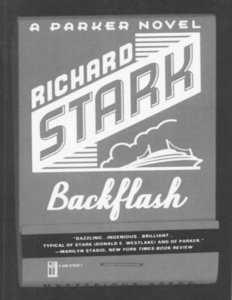
Book Review: Richard Stark, Backflash (1997)


This is the sort of Parker novel that I like best: it focuses fairly narrowly on Parker planning and executing a heist and then dealing with the aftermath. So why didn’t I like it more? Why did I actually find it a wee bit tedious? The answer, I think, is that while Starklake ably executes the Parker formula, it feels like a formula this time out. Starklake doesn’t play with his own conventions as he sometimes does—he just marches through them. Of course, this wouldn’t be my reaction if this were my first encounter with Parker, in which case I would probably think this was a great book. More than anything, this all suggests that I ought to take a break from Parker. CHARACTER DEVELOPMENT ALERT: In Backflash, Parker laughs at a joke. Grade: C+

Monday, May 14, 2012

Pulp Poem of the Week


Just smart
enough
to get
into
trouble.
          
     Richard Stark
     Comeback
     1997

Thursday, May 10, 2012

Book Review: Richard Stark, Comeback (1997)


The coolest thing about Parker’s comeback is its lack of fanfare—when it appeared, this was the first Parker novel in 23 years, but that fact is referenced only in the novel’s title. Other than that, it’s a completely ordinary Parker novel (which is to say, a very good Parker novel) that could just as easily have been published in 1967 as 1997, a few cultural references notwithstanding. Comeback drags only in its final act, as Parker novels sometimes do, when it turns into a cat-and-mouse game of who-is-going-to-kill-whom. Grade: B