Monday, August 27, 2012

Pulp Poem of the Week


In the cool Mississippi
breeze he swung
to and fro from the dogwood tree to see
himself completely hung.
Ah! no conjure man
or ghost can
so neatly tread
this, God’s free air,
no fetish grant the steady stare
of these dead
eyes. But, oh, around my
neck the manila snake strangled the last cry
and boxed it in my throat
and what I had to say to them, I wrote
with pencilings of pain,
in blood that leaped through every vein;
I told then what I had to say
and last I stuck my tongue
far out at them to their dismay
while I flung my unwashed feet
in the last great kick; and the last great beat
within me
fled from Mississippi.
  
     Hal Ellson

     “Gumbo Hangs High
     1936

Tuesday, August 21, 2012

Book Review: Seicho Matsumoto, Pro Bono (1961)


My first Seicho Matsumoto novel was Points and Lines (1958), the whodunit that made him famously popular in Japan. That mystery hinged on a detailed analysis of train timetables, a subject that Japanese readers love but that many American readers find tedious. Perhaps more to American taste—and certainly more to the taste of noir fans—will be Matsumoto’s Pro Bono (1961), which has just appeared in English for the first time. Kiriko Yanagida, a young woman from Kyushu, travels to Tokyo to solicit to the services of a famous lawyer to represent her brother, whom she believes has been falsely accused of murder. Kiriko has no way to pay the lawyer, and he briefly considers but rejects the possibility of taking her case pro bono. The bulk of the novel tells of the events that follow: the fate of Kiriko’s brother; how his fate affects her; and how all of this comes back to affect the lawyer. Grade: B+

Monday, August 20, 2012

Entire Cover: Gil Brewer, Redheads Die Quickly and Other Stories (2012)


(click on image to see it all!)

Pulp Poem of the Week


When you see
a woman writhing
in agony, laughter
is unimaginative.


     Fuminori Nakamura

     The Thief
     2009
     (trans. Satoko Izumo and Stephen Coates)

Wednesday, August 15, 2012

Book Review: Charles Williams, All the Way (1958)


Noir believes in love at first sight—or at least that men are capable of love at first sight—or at least that men are capable of lust at first sight, which they convince themselves is love. Case in point: Charles Williams’ All the Way, in which narrator Jerry Forbes falls at once for Marian Forsyth, allowing her to manipulate him as she sees fit. As is often the case, readers will have difficulty accounting for Jerry’s obsession with Marian, who is not the typical noir sexual bombshell, beyond the fact that the plot requires it. Marian’s plans hinge on the fact that Jerry’s voice is indistinguishable from that of her former boss and lover, and therefore Jerry can impersonate him on the phone as per Marian’s instructions. The first half of All the Way is somewhat slow; the book establishes its premise quickly, but the plot takes a while to get moving. The second half is fairly intense as Jerry encounters unexpected obstacles in pulling off his impersonation. On the whole, this one is well worth seeking out. Grade: B+

Monday, August 13, 2012

Pulp Poem of the Week


If you pick up a starving dog
and make him prosperous,
he will not bite you.
This is the principle difference
between a dog and a man.
Mark Twain
Pudd’nhead Wilson
1894

Monday, August 6, 2012

Book Review: Dave Zeltserman, The Dame (2012)


Two entries into the series, it is clear that the novelettes in The Hunted are very much parts of a whole. Thus, I feel odd reviewing them individually, rather as if I were reviewing individual chapters of a book as I went along, but I can say, at the very least, that they are entertaining chapters. With The Dame, we are squarely in Parker-Stark territory, and the reading is quick and good, even if Dan Willis lacks Parker's winning personality. Grade: B

Pulp Poem of the Week


Why don’t
people go to
the police?

     Gil Brewer
     “Home-Again Blues”
     1956

Thursday, August 2, 2012

Book Review: Charles Williams, Talk of the Town [a.k.a. Stain of Suspicion] (1958)


Talk of the Town is an Everyman noir-cum-whodunit via a damsel in distress with occasional patter tossed in from a screwball comedy. The premise is vaguely similar to an earlier Charles Williams novel, Go Home, Stranger (1954), as both feature amateur outsiders attempting to solve crimes (though Bill Chatham, protagonist of Talk of the Town, is a former professional). The plotting of Talk of the Town is thin, largely because so many of Chatham’s decisions are based on there-was-a-small-chance-but-it-was-the-only-chance logic. Nevertheless, Talk of the Town is somewhat more engrossing than Go Home, Stranger because Williams does a better job of making his protagonist a participant in (rather than an observer of) the plot. Grade: C+

Monday, July 30, 2012

Pulp Poem of the Week


If someone steals your sandals
while you’re at the public baths,
you steal someone else’s.
If you’re upset about your brother’s death
why not kill a complete stranger?
Osamu Tezuka
MW
1976-1978
(translated by Camellia Nieh)

Sunday, July 29, 2012

My Ten Favorite Noir Novels of All Time at This Moment


From out of the darkness, here I have found the greatest joy:

Frank Norris, McTeague (1899) 
Martin M. Goldsmith, Detour (1939) 
William Lindsay Gresham, Nightmare Alley (1946)
Bill S. Ballinger, Portrait in Smoke (1950)
Gil Brewer, A Killer Is Loose (1954)
Jim Thompson, A Hell of a Woman (1954) 
Charles Williams, A Touch of Death (1954)
James McKimmey, The Long Ride (1961) 
Richard Stark, The Score (1964)
Natsuo Kirino, Out (1997)

Wednesday, July 25, 2012

The Best (and Worst) Novels of Gil Brewer


Between 1951 and 1967, Gil Brewer published 30 noirboiled novels.  Here are my picks for the must-reads and the must-avoids:

The best . . .

Hell’s Our Destination (Gold Medal, 1953): Brewer found his voice in his fifth published novel. Bleak House in the Florida swamp.

A Killer Is Loose (Gold Medal, 1954): Brewer thought that this tale of an everyman and a psychopath was his best novel. He may have been right.

The Brat (Gold Medal, 1957): The title character is perhaps Brewer’s most memorable femme fatale—and she’s got a lot of competition.

A Taste for Sin (Berkley, 1961): Or maybe this novel contains Brewer’s most memorable femme fatale. Conveniently, she happens to be married to a bank clerk.

Memory of Passion (Lancer, 1962): An ambitious narrative blending a busted marriage and a serial killer.

The worst . . .

Some Must Die (Gold Medal, 1954): Brewer’s attempt at a western. Much of the prose is incoherent.

The Angry Dream (Mystery House, 1957): Thin plot with a laugh-out-loud ending. Also published as The Girl from Hateville.

Appointment in Hell (Monarch, 1961): Even a plane crash in the wilds of South America cannot dampen the horniness of the human spirit.

Sin for Me (Banner, 1967): Brewer running on fumes, lurching his way to one last noirboiled paycheck.

Monday, July 23, 2012

Pulp Poem of the Week


If
the money existed
Gil Brewer
The Tease
1967

Saturday, July 21, 2012

Book Review: Dave Zeltserman, The Hunted (2012)


In 
Manhunt and other noirboiled digests of the 1950s, unusually long stories, which often had short numbered chapters, were called “novelettes.” If the noirboiled novelette should become popular in the 21st century, it will be because these stories—too short to stand alone as novels, too long for most magazines—have found their perfect home: e-readers. Dave Zeltserman, the hardest-working man in noirboiled, gives the genre a go with The Hunted Series. The first entry in the series details the backstory and early career of hitman Dan Willis. My favorite thing about Zeltserman’s books is that his plots never go exactly where I expect them to, which is a joy when you spend your time rutting endlessly in the same genre. (The most important lesson that Zeltserman learned from Jim Thompson is this: Great writers take chances.) This time out, the unexpected twist nearly crushed my credulity, but I clicked through this novelette fast enough that I will surely read the next in the series. Grade: B-

Thursday, July 19, 2012

Book Review: Gil Brewer, Sin for Me (1967)


Sin for Me marked the thudding end of Gil Brewer’s seventeen-year career as an author of noir paperback originals (1951-1967). Conventional wisdom says that the 1950s were Brewer’s artistic glory years and that his 1960s output was spotty at best. More accurate is to say that Brewer was more prolific in the 1950s and therefore wrote more good novels in that decade. (He wrote more stinkers in the 1950s, too.) Sin for Me has all the elements of a top-tier Brewer novel patched together ineptly. A pair of femmes fatale and $400,000 in stolen cash upend the life of Jesse Sunderland, an everyman realty agent whose woodenly introspective first-person narration plays a major part in spoiling the fun. Brewer justifies each turn in the narrative with a three-part formula: (1) Jesse has an intuition about a character or an event; (2) Jesse immediately decides that his intuition must be true; (3) therefore Jesse’s intuition is true. At times, you can almost hear Brewer whispering into Jesse’s ear, “Come on, man, we can make that word count—I know we can!” An unfortunate end to a great run. Grade: D

Monday, July 16, 2012

Advertisement: Gil Brewer, Redheads Die Quickly and Other Stories (2012)


from the Winter 2012 catalog of the University Press of Florida
to see the full ad, click on the image

Pulp Poem of the Week


She is
vicious,
selfish,
totally irresponsible,
physically unattractive.
And yet
there is something . . .

     Jim Thompson
     The Golden Gizmo
     1954

Friday, July 13, 2012

Book Review: James Sallis, Drive (2005)


I had read so many raves for Drive that I expected something great, but here’s what I got instead: a standard-issue noir anti-hero from the Stark-Parker Division; a standard-issue noir plot made not much fresher by its chronologically jumbled narration; enjoyable tangets into the world of Hollywood stunt-driving; and a shout-out to Jorge Luis Borges. In sum, a disappointment. Grade: C+

Tuesday, July 10, 2012

Book Review: Norman Klein, No! No! The Woman! (1932)


I may read Norman Klein’s No! No! The Woman a second time, not because I liked it but because I’m still trying to figure out what I just read. I mean, how many vintage hardboiled novels end by quoting Friedrich Nietzsche? I learned of this novel’s existence from a 1932 review in the New York Times. The opening sentence of the review declares that Klein “has aligned himself with the hard-boiled school of mystery writers, and he always calls a spade a spade except when he happens to think of some uglier term for it.” And the review concludes, “In brief, the tale has no moral and no morals.” Sounds promising, right? In the main, the novel is a sloppily plotted whodunit. Its protagonist, Leslie Cobb, returns stateside from Europe after the death of her great-aunt, Sophia Pollard. Cobb soon comes to believe that her aunt was murdered and begins amateur sleuthing. She resembles a hardboiled detective mainly in her irreverent wisecracking. It is easy to spot things that might have been shocking in 1932—though today, a foot fetishist (for example) will doubtless disturb fewer readers. Surprisingly, just when it seems that the narrative belongs entirely to Cobb, a conventional hardboiled detective (name: Lee M. Carnley) appears on the scene. Ultimately, however, the narrative becomes Cobb’s again. This is probably a good thing, but I wouldn’t swear to it. Grade: C+

Monday, July 9, 2012

Pulp Poem of the Week


If I just talked
without busting you first,
you wouldn’t
remember.

     Gil Brewer
     “With This Gun—”

     1951

Monday, July 2, 2012

Pulp Poem of the Week


Courage!
Why,
what is more courageous
than a piece of steel?

     Ernest Crosby
     Captain Jinks, Hero
     1902

Monday, June 25, 2012

Pulp Poem of the Week


a struggling fly,
already trapped
but still able to move,
trailing over flypaper


     Cornell Woolrich

     “The Light in the Window”
     1946

Monday, June 18, 2012

Pulp Poem of the Week


Human beings must sleep.
Give them time enough,
and they can sleep anywhere,
in any situation.
Even on the floor of Purgatory,
even in the mouth of Hell,
they will sleep.
Night comes and they will sleep.


     Cornell Woolrich
     Savage Bride
     1950

Thursday, June 14, 2012

Book Review: Dave Zeltserman, Killer (2010)


The final installment of Dave Zeltserman’s man-out-of-prison trilogy is the most low-key of the three. When mob hitman Leonard March goes free, he has every reason to believe that he will soon be rubbed out himself—he did, after all, get a reduced sentence by ratting out his boss. So he takes a job as a janitor and waits. The dark joy of these novels, however, is that they never quite go where you think they will. Their episodic plots resist formula. Grade: B-

Monday, June 11, 2012

Pulp Poem of the Week


Has anyone supposed it
lucky to be born?
I hasten to inform him or her
it is just as lucky to die,
and I know it.


     Walt Whitman

     “Song of Myself”
     1855

Sunday, June 10, 2012

Book Review: Fuminori Nakamura, The Thief (2009)


Publishers Weekly says that The Thief’s antihero is “at once as believably efficient as Donald Westlake’s Parker and as disaffected as a Camus protagonist.” To which I will add, it’s the Parker that makes you want to keep reading, and the Camus that makes you want to stop. Grade: C

Wednesday, June 6, 2012

Book Review: Jim Thompson, The Golden Gizmo (1954)


Six months from now, I will remember three things about this novel: (1) A female characters gets pistol-whipped in the breasts; (2) the protagonist revives a dying woman with coffee and then immediately has sex with her; and (3) there is a talking dog. Grade: D

Monday, June 4, 2012

Pulp Poem of the Week


I slapped him across the mouth.
I swung my hand back and forth,
slapping him palm and backhand.
The matron pounded on the door
and rushed in. I told her to
beat it. “I’m slapping hell
out of a client,” I said, “and
I don't want to be disturbed.


     Jim Thompson
     The Criminal
     1953

Monday, May 28, 2012

Pulp Poem of the Week


Cash is
the hardest to find
and
the easiest to deal with.


     Richard Stark
     Backflash
     1997

Thursday, May 24, 2012

Book Review: Cornell Woolrich, Savage Bride (1950)


Cornell Woolrich puts an everyman and a femme fatale into an H. Rider Haggard blender.  Beware:  These characters don’t spit—they expectorate.  Grade: D

Monday, May 21, 2012

Pulp Poem of the Week


a stream of
pleasant sound
that seemed
to be saying,
Nothing matters.

          David Goodis
          Down There
          1956

Friday, May 18, 2012

Book Review: Jim Thompson, The Criminal (1953)


The title of this low-key masterpiece (low key for Jim Thompson, anyway) is either highly ironic or an oblique reference to almost every character in the book (or, of course, maybe both). In the main, its title refers to Bob Talbert, a teenager accused of killing a girl after she seduces him. As the narrative progresses, however, the fate of our criminal (if criminal he be) becomes increasingly beside the point. The story is told by a series of first-person narrators, each representing less a perspective than an agenda. Thus, the narrators emerge as criminals of a different sort, self-interested and mostly unconcerned with the truth of the affair. Herein lies the title's irony, as The Criminal frustrates the focus that its title promises. Some of Thompson's most famous novels feature the psychological disintegration of their protagonists. In The Criminal, it is the plot itself that disintegrates. Grade: A

Thursday, May 17, 2012

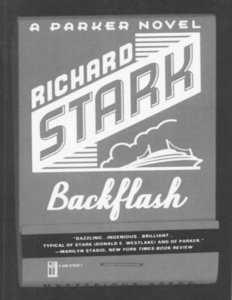
Book Review: Richard Stark, Backflash (1997)


This is the sort of Parker novel that I like best: it focuses fairly narrowly on Parker planning and executing a heist and then dealing with the aftermath. So why didn’t I like it more? Why did I actually find it a wee bit tedious? The answer, I think, is that while Starklake ably executes the Parker formula, it feels like a formula this time out. Starklake doesn’t play with his own conventions as he sometimes does—he just marches through them. Of course, this wouldn’t be my reaction if this were my first encounter with Parker, in which case I would probably think this was a great book. More than anything, this all suggests that I ought to take a break from Parker. CHARACTER DEVELOPMENT ALERT: In Backflash, Parker laughs at a joke. Grade: C+

Tuesday, May 15, 2012

Book Review: David Goodis, Down There [a.k.a. Shoot the Piano Player] (1956)


Why do so many readers rank David Goodis so highly in the pantheon of noir? My theory goes like this: His best books, including Down There, are remarkable primarily for their restraint. Goodis does his best writing when he doesn’t overtax his talent by trying to do too much. Thus, good Goodis gives you no complicated criminal plots, no overwrought sexual hijinks. He’s simple and he’s bleak, and therefore he gets credit for a kind of noir purity and for a corresponding artistic ambition. But in this realm, art happens only when character happens, and Down There’s characters are thin. The most notably thin is protagonist Eddie Lynn, who is more husk than human. In fact, Eddie has cultivated his huskness as a psychic defense against his painful past. His response to most everything that goes on around him is an empty smile. Eventually, of course, Eddie is forced into substantially more action than this, but, as is typically the case with Goodis, as the action accelerates, the artistry deteriorates. One of Goodis’ great strengths, however, is righting himself on the final page and ending on a perfect note. Grade: B+

Monday, May 14, 2012

Pulp Poem of the Week


Just smart
enough
to get
into
trouble.
          
     Richard Stark
     Comeback
     1997

Thursday, May 10, 2012

Book Review: Richard Stark, Comeback (1997)


The coolest thing about Parker’s comeback is its lack of fanfare—when it appeared, this was the first Parker novel in 23 years, but that fact is referenced only in the novel’s title. Other than that, it’s a completely ordinary Parker novel (which is to say, a very good Parker novel) that could just as easily have been published in 1967 as 1997, a few cultural references notwithstanding. Comeback drags only in its final act, as Parker novels sometimes do, when it turns into a cat-and-mouse game of who-is-going-to-kill-whom. Grade: B

Monday, April 30, 2012

Pulp Poem of the Week


loving someone
always
requires you to not
love others

Koushun Takami
Battle Royale

1999
(translated by Yuji Oniki)

Monday, April 23, 2012

Pulp Poem of the Week


how has love turned
     to hate?  Worse
how has love
     turned to indifference?

     Steve Finbow

     Nothing Matters
     2012

Monday, April 16, 2012

Pulp Poem of the Week


He doesn’t talk
much at all.
He just makes
you want to
step to one side.

     Richard Stark
     Butcher’s Moon
     1974